It sounds like something for banks and hospitals. It’s really just knowing who decides what, and writing it down.
Say “IT governance” to a small business owner and you’ll usually get a polite nod and a change of subject. It sounds like a binder, a committee, and a consultant’s invoice.
It’s none of those. At its simplest, IT governance answers four questions:
- Who is responsible for our technology?
- What are the rules for how it’s used?
- Who decides when something changes?
- How do we know the rules are being followed?
That’s it. And most small businesses are already making these decisions every day. They just make them by habit, by whoever happens to be around, and by memory.
What “no governance” looks like
You’ve probably seen a version of this.
Picture a 25-person office. The person who set up the Wi-Fi and the file shares left two years ago. Nobody is sure who holds the login for the domain. A new hire gets the same access as the last person in that seat, plus whatever they ask for. Someone buys a cloud tool with a company card because it solved a problem, and now client files live somewhere IT doesn’t know about. The backup was set up by someone who has since moved on.
Nothing here is reckless. Every decision made sense at the time. But together they add up to an environment where nobody can say clearly what exists, who owns it, or what happens if something goes wrong.
That’s the real cost of skipping governance. It isn’t a fine or a failed audit. It’s that the answers live in people’s heads, and people leave, get busy, or are on vacation the day you need them.
Why IT governance matters more as you grow
At five people, the owner can hold all of this in their head. At 20 or 30, they can’t, and shouldn’t have to.
It also matters outside the office:
- Clients increasingly ask how you protect their information, especially in legal, accounting, and healthcare work.
- Insurers may ask about things like MFA, backups, and access controls when you apply or renew cyber coverage.
- Privacy obligations such as PIPEDA expect you to take reasonable steps to protect personal information. Governance is how you show those steps exist. (We provide guidance that supports your compliance efforts. We don’t certify compliance.)
Being able to answer these questions calmly, with something written down, is a real business advantage.
The five pieces of governance a small business needs
You don’t need all of an enterprise framework. You need these five, in plain language.
1. Ownership
Name one person accountable for IT decisions, even if they aren’t technical and even if an outside provider does the hands-on work. Someone should be the person who says “yes, we’re doing that” or “no, not yet.”
2. Access rules
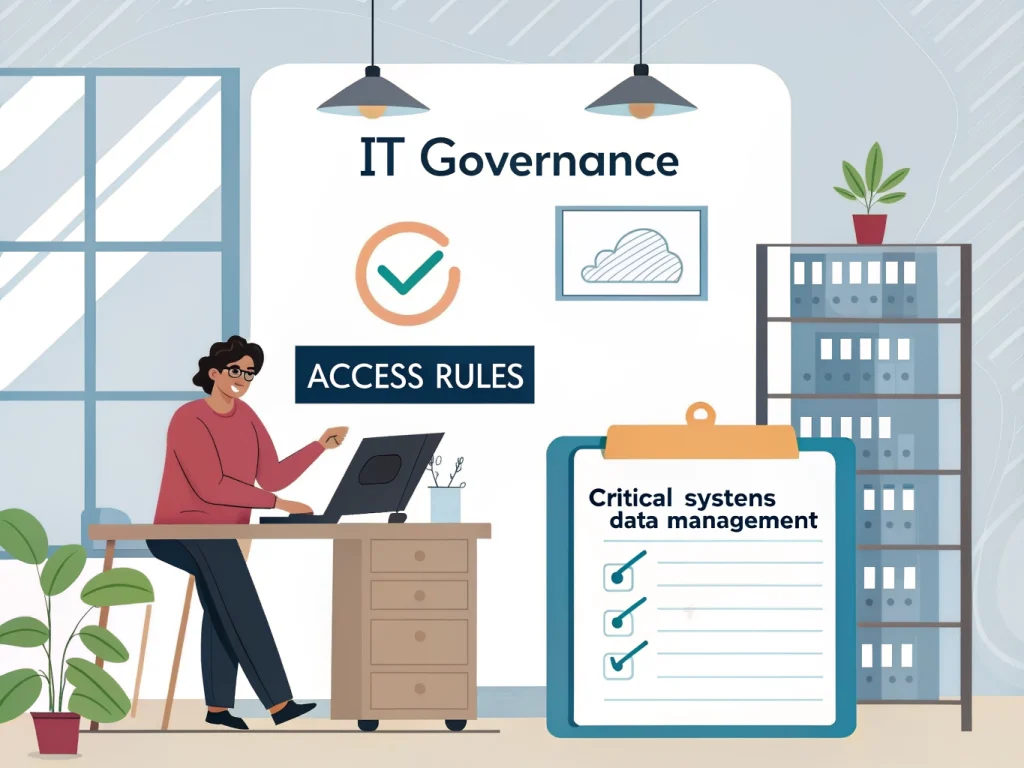
Decide how access is given, changed, and removed. Who approves a new account? What happens on someone’s last day? Who can be an administrator? A one-page checklist for joiners and leavers covers most of it.
3. Decisions about change
Before adopting a new tool, moving data, or changing a system, who signs off? Even a short “does this touch client data, and who owns it?” check stops surprise tools from quietly appearing.
4. Documentation
Keep a short, current record of what you have: key systems, vendors, where data lives, how backups work, who to call. It doesn’t need to be long. It needs to be findable by someone other than the person who wrote it.
5. Regular review
Set a rhythm. Once a quarter, look at who has access, whether backups were tested, which devices are behind on updates, and what’s changed. Governance that isn’t reviewed slowly stops being true.
A starter you can do this month
Open a document and write one page with these headings:
- IT owner and backup contact
- Critical systems and where the data lives
- How we add and remove access
- How we back up, and when we last tested a restore
- Our vendors and who holds each account
- When we review all of this (put the date in the calendar)
Don’t polish it. A rough page that exists beats a perfect one that doesn’t.
It’s not about paperwork
Good governance isn’t there to slow people down. Done well, it does the opposite: new hires get set up faster, problems get resolved faster, and nobody has to hunt for a login in a crisis. It gives your team clear answers and gives you confidence in the ones you can’t check yourself.
Where to start
If you’re not sure where your business stands, our free IT assessment takes about three minutes and gives you an IT readiness score. It’s a simple way to see which of these areas need attention first, with no obligation.
A2 SecureCloud is a Canadian-owned managed IT and cybersecurity company serving small businesses across Canada, with on-site support in Durham Region, Ontario.